
Digital Motion X-Ray and Ehlers-Danlos Syndrome
If you live with Ehlers-Danlos Syndrome (EDS), you may know this frustration well. You have chronic neck pain, headaches, dizziness, fatigue, or a constant feeling that your neck can't hold your head up. Yet your X-rays and MRI come back “normal.”
Feeling that something is wrong while being told everything looks fine is exhausting. In many cases, the problem isn't that nothing is wrong. It's that the right test hasn't been done yet. Digital Motion X-Ray (DMX) is designed to show what standard imaging can't: how your spine moves.
Why Ehlers-Danlos Syndrome Patients Often Struggle to Get Clear Answers
Traditional X-rays and MRI scans are static. They capture a single still image while you lie down or stand perfectly still. But many problems linked to ligament laxity and joint instability only show up during movement.
For people with EDS, the upper cervical spine may look stable in a still image and then shift abnormally as the neck bends, tilts, or rotates. A snapshot can miss that completely.
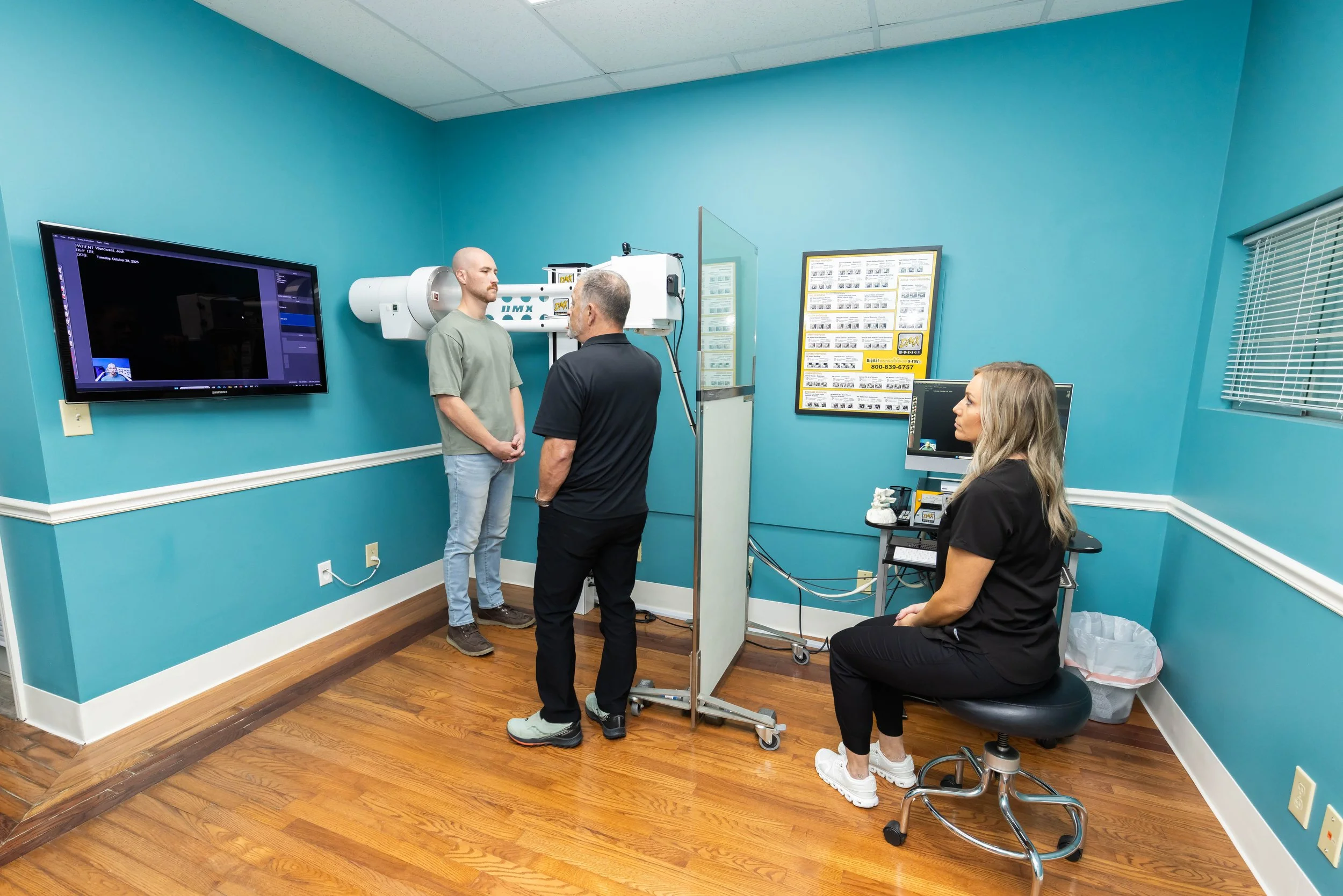
Digital Motion X-Ray, also called motion fluoroscopy, records a live video X-ray of your spine while you gently move your neck. Instead of guessing from a still picture, your provider can watch how the vertebrae move together, and where they don't. This can reveal abnormal motion patterns and areas of instability that traditional imaging may miss.
For many patients, finally seeing a possible explanation for their symptoms brings real relief and a clearer path forward.
How Is a Digital Motion X-Ray Performed?
The process is simple and non-invasive. Here's what to expect:
Positioning. You'll be positioned comfortably, usually seated or standing, in front of the fluoroscopy unit.
Guided movement. A technician will guide you through gentle movements of the neck, such as bending forward, tilting back, turning, and side bending.
Live recording. The device records a continuous X-ray video as you move. No injections, dyes, or needles are involved.
The exam itself is typically brief, and you can go about your day afterward. Because DMX uses X-ray technology, it does involve radiation exposure. Your provider will make sure the study is appropriate for your situation before recommending it.
If I Already Had X-Rays and MRI, How Is Digital Motion X-Ray Helpful?
This is one of the most common questions we hear, and it's a fair one. X-rays and MRI are valuable tools. They show structure very well, such as bones, discs, and soft tissue. But they don't show function, meaning how the spine behaves when you move.
Think of it like trying to judge how a door works by looking at a photo of it closed. You can see the hinges, but you can't tell whether it swings smoothly or sticks halfway. DMX adds the missing information by showing the spine in motion.
DMX doesn't replace your other imaging. It works alongside it, giving your provider a more complete picture so you aren't left with “your scans look fine” as the final answer.
Benefits of Digital Motion X-Ray (DMX)
For patients with suspected spinal instability, DMX offers several advantages:
Real-time view. It shows how the spine moves, not just how it looks at rest.
Detects motion problems. It can reveal abnormal movement, ligament laxity, and instability that may not appear on still images.
Non-invasive. There are no needles, injections, or recovery time.
Objective information. Recorded video and measurements give you and your providers something concrete to review.
Better-informed care. Findings can help guide a treatment plan and support conversations with your other healthcare providers.
Validation. Many patients feel heard for the first time when their symptoms are connected to something visible.
Common Misconceptions About Digital Motion X-Ray
“It's the same as a regular X-ray.”
Not quite. A regular X-ray is a still image. DMX is a video study that captures movement, which is what makes it useful for finding instability.
“It's painful or uncomfortable.”
The movements are gentle and kept within your comfortable range. You aren't forced or pushed into any position.
“If my MRI is normal, there's nothing wrong with my spine.”
A normal MRI means no structural problem was seen in that still image. It doesn't rule out a movement-related issue.
“DMX is only for people with EDS.”
While it can be especially helpful for EDS and other hypermobility conditions, DMX is also used to evaluate injuries such as whiplash and other spinal problems that may not show up on static imaging.
“DMX can diagnose Ehlers-Danlos Syndrome.”
It can't. DMX shows how the spine moves, and its findings can support the overall clinical picture, but EDS itself is diagnosed through clinical evaluation and, for some types, genetic testing.
Digital Motion X-Ray in Owasso and Tulsa
Standridge Clinic offers Digital Motion X-Ray in Owasso, Oklahoma, serving patients from Tulsa and surrounding communities. If you've been told your imaging is normal but you still know something isn't right, we're here to listen and help you look deeper.
Ready for clearer answers? Schedule an appointment or call us at (918) 272-7439.
Frequently Asked Questions
-
Digital Motion X-Ray is a video X-ray, also known as motion fluoroscopy, that records your spine as you move. It doesn't diagnose EDS on its own. Instead, it helps identify abnormal motion and instability in the neck, which can support a diagnosis made through clinical evaluation and, when appropriate, genetic testing. It also helps your providers understand which parts of your spine need the most support.
-
No. Regular X-rays can't detect EDS because it is a connective tissue condition. EDS is diagnosed through a physical exam, your history, established diagnostic criteria, and genetic testing for certain types. Standard X-rays also capture a still image, so they may miss instability that only appears during movement. That's one reason many patients are told their imaging is normal even while symptoms continue.
-
Symptoms that are sometimes associated with cervical instability include:
Chronic neck pain or a feeling that the neck can't support the head
Headaches, especially at the base of the skull
Dizziness or lightheadedness
Brain fog or fatigue
Neck clicking, popping, or a sense of slipping
These symptoms overlap with many other conditions, so they can't confirm instability on their own. A proper evaluation, which may include Digital Motion X-Ray, is the way to find out. If you experience sudden severe headache, weakness, numbness, trouble speaking or swallowing, or loss of coordination, seek emergency medical care right away.
